Decoding hemophilia - A conceptual study of hemophilia in ayurvedic and contemporary perspectives
Abstract :
The inherited deficiency of blood coagulation factors results in lifelong bleeding disorders collectively known as Hemophilias. The most commonly affected factors are Factor VIII (FVIII) and Factor IX (FIX), whose genes are located on the X chromosome. Mutations in these genes lead to X-linked recessive disorders, specifically Hemophilia A and B. According to the World Federation of Hemophilia (WFH), the global prevalence of Hemophilia A is approximately 1 in 10,000, and for Hemophilia B, 1 in 50,000. Patients experience spontaneous bleeding, prolonged bleeding post-trauma or surgery, and internal hemorrhages, particularly in joints and muscles. These episodes often result in pain, immobility, and long-term disability. While advancements in biomedical science, such as early diagnosis and recombinant factor therapy, have improved prognosis, challenges like treatment accessibility and the development of inhibitors persist—especially in resource-limited settings. Ayurveda, the traditional Indian system of medicine, offers a holistic view of disease that incorporates genetic, metabolic, and lifestyle factors. Although Hemophilia is not explicitly mentioned in Ayurvedic texts, several conditions such as Raktapitta, Pandu, Kamala, VataRakta, Shotha, and Yakrutadushti, Raktadushti bear striking resemblance in pathogenesis and clinical features. These arise primarily from the vitiation of Pitta Dosha and Rakta Dhatu, often associated with Ushna, Sara, and Drava gunas. The concept of Beeja Dosha and Adibala Pravritta Vyadhi parallels the genetic basis of Hemophilia. This article offers a comparative study of Hemophilia from both Ayurvedic and contemporary perspectives, emphasizing the potential of an integrative treatment approach to enhance symptom management and patient well-being, particularly in low-resource settings.
Keywords:
Hemophilia, Clotting Factors, Raktapitta , Genetic Disorders, Beeja Dosha
Introduction :
The inherited deficiency of blood coagulation factors leads to lifelong bleeding disorders commonly called Hemophilias. The factors most frequently found deficient in Hemophilias are factors VIII (FVIII) and IX (FIX), whose genes are located on the X chromosome and, when mutated, cause the X-linked recessive traits Hemophilia A and B[1]. WFH (World Federation of Hemoplilia) global estimate of the prevalence of bleeding disorders. [2] More than 1 in 10000 people is estimated to have a bleeding disorder.
Hemophilia A: 105 in 1 million* (more commonly cited as 1 in 10,000 + )
Hemophilia B: 28 in 1 million* (more commonly cited as 1 in 50,000 + )
Patients frequently suffer from spontaneous bleeding, prolonged bleeding after injuries or surgery, bleeding internally, mostly in joints, muscles, and the brain.[3] Each bleeding episode causes immobilization and severe pain and can result in permanent disability. Advances in biomedical science have significantly improved the prognosis through early diagnosis, prophylactic factor replacement therapy, and recombinant clotting factors. Yet, access to treatment remains a major challenge in low-resource settings, and the development of inhibitors (neutralizing antibodies against clotting factors) complicates therapy in 20–30% of patients with severe Hemophilia.
Ayurveda, the traditional Indian system of medicine, offers a holistic understanding of health and disease that includes genetic, metabolic, and lifestyle factors. According to Aacharya Sushruta, Blood is the primary nourisher of the body, and it is through blood that the body is sustained. Therefore, one must carefully protect the blood, because in reality, blood itself is life. [4] Though Hemophilia is not directly mentioned in the Ayurvedic classics, the liver as a root organ, along with the clotting nature of blood described in the Samhitas, shows a conceptual resemblance to the etiology of Hemophilia. Several disorders (Raktapitta, Pandu, Kamala, VataRakta, Shotha, and Raktadushti, Yakrutadushti) from Samhitas have resemblance to Hemophilia in pathogenesis and symptomatology. These are due to Pitta Dosha dushti and Rakta Dhatu dushti because of ushna, sara and drava guna vikruti. The concept of Beeja Dosha (genetic defects) and Adibalapravritta vyadhi (hereditary diseases) in Ayurveda corresponds with the genetic etiology observed in Hemophilia. [5]
An integrative approach combining evidence-based Ayurvedic support with standard modern Hemophilia care may offer enhanced outcomes. There is a growing need to explore such integrative models for chronic genetic disorders, especially in resource-limited countries where access to lifelong factor therapy remains inadequate.
This article aims to present a comprehensive review and conceptual correlation of Hemophilia with Ayurvedic principles. It explores clinical similarities, etiological overlaps. Through a detailed comparative analysis of classical Ayurvedic descriptions and contemporary medical literature, the study seeks to establish Ayurvedic equivalents or explanations for Hemophilia and its manifestations. Analyzing the scope of Ayurvedic therapies in reducing symptoms and improving patient well-being, and highlighting the importance of future clinical research in establishing integrative protocols.
While factor replacement remains the cornerstone of treatment, Ayurveda may contribute significantly in preventive care, symptomatic relief, and lifestyle management. Hence, bridging the gap between traditional and modern approaches could pave the way for holistic, patient-centered care.
AYURVEDIC PERSPECTIVE :
In Hemophilia, the key physiological components involved are blood, specific clotting factors (primarily Factor VIII and IX), and the liver, which plays a central role in synthesizing these coagulation proteins. From the Ayurvedic perspective, these elements correspond closely to Pitta Dosha, Rakta Dhatu, and Yakrut (liver).
A) Yakrut (Liver) –
1) Formation of Blood :
- स खलु आप्यो रसः यकृत्प्लीहानौ प्राप्य रागमुपैति । सु.सू.१४/४[6]
- यत्तु यकृत्प्लीह्नोः पित्तं तस्मिन् रंजकोग्निरिति संज्ञा। स च रसस्य रागकृत्। सु.सू.२१/१०[7]
After digestion of food, the Rasa Dhatu (the primary nutrient essence) is transported to the liver, where it undergoes Ranjana (coloration) and Pachana (metabolic transformation) due to the action of Ranjaka Pitta present in the liver. This process leads to the formation of Rakta Dhatu (blood), making the liver the primary site of blood formation in Ayurvedic physiology.
2) Formation of Liver :
- गर्भस्य यकृत्प्लीहानौ शोणितजौ | सु.शा. ४/२५[8]
During fetal development, the liver and spleen are formed from the blood.
3) Mulasthan of Raktavaha Srotas :
- शोणितवहानां स्रोतसां यकृन्मूलं प्लीहा च। च.वि. ५/८[9]
- रक्तवहे द्वे । तयोर्मूलं यकृत्प्लीहानौ रक्तवाहिन्यश्च धमन्यः । सु.शा. ९।१२[10]
The Mulasthan (root locations) of the Raktavaha Srotas are the liver and spleen.
4) Raktadhara Kala :
- द्वितीया रक्तधारा मांसस्याभ्यन्तरतः, तस्यां शोणितं विशेषतश्च सिरासु यकृत्प्लीह्रोश्च भवति ।। सु.शा. ४/१०[11]
The second type of Kala is known as Raktadhara Kala. It is located within the Mansa Dhatu (muscle tissue) and is responsible for the circulation of Rakta (blood). This Kala is specifically found in the veins (Sira), liver (Yakrit), and spleen (Pleeha).
5) Yakrut : Origin of Raktapitta
- प्रभवत्यसृजः स्थानात्प्लीहतो यकृतश्च तत्। वा.सू. ३/४[12]
The origin of Raktapitta lies in the primary sites of Rakta (blood), namely the liver (Yakrit) and spleen (Pleeha).
B) Pitta Dosha –
1) Ushna Guna of Pitta :
- औष्ण्यतैक्ष्ण्यलाघववैशद्यगुणलक्षणं पित्तम् । सु.सू. ४२।८[13]
- पित्तं सस्नेहतीक्ष्णोष्णं लघु विस्रं सरं द्रवम् । वा.सू. १/११[14]
- सस्नेहमूष्णं तीक्ष्णं च द्रवमम्लं सरं कटु । च.सू. १/६०[15]
- उष्ण – स्वेदने ऊष्णः । हेमाद्रिटीका[16]
Due to the (Ushna Guna), the Siras (veins) and Srotasas (channels) undergo expansion, which facilitates the flow of Blood in liquid form through them.
2) Role of Ushna Guna of Pitta :
- पित्तात् पीतासितं रक्तं स्त्यायत्यौष्ण्याच्चिरेण च । च.सू. २४/२०[17]
- पित्तात् पीतासितं विस्रमस्कन्द्यौष्ण्यात्सचन्द्रिकम् । वा.सू. २७/४०[18]
- श्यावं विस्त्रमनिष्टं पिपीलिकामक्षिकाणामस्कान्द च पित्तदुष्टम् | सु.सू. १४/२२[19]
Due to the increase in the Ushna Guna of Dushit Pitta, heat is imparted to the Rakta (blood), making it Aaskandi meaning it does not clot quickly.
C) Rakta Dhatu –
1) Importance of blood :
- देहस्य रुधिरं मूलं रुधिरेणैव धार्यते । तस्माद्यत्नेन संरक्ष्यं रक्तं जीव इति स्थितिः। सु.सु१४/४४[4]
- जीवनं (श्रेष्ठकर्म रक्तस्य ) अ.ह.सू. ११।४[20]
According to Acharyas, importance to Rakta is given by considering it as Jeeva.
2) Quality of Shuddha Rakta :
- इंद्रगोपप्रतीकाशम् असंहतम् अविवर्ण प्रकृतिस्थं जानीयात् । सु.सू. १४।२२ [21]
- मधुरं लवणं किञ्चिदशीतोष्णमसंहतम् । वा.सू. २७/२[22]
Shuddha Rakta (Pure blood) is Asanhata, meaning it is neither too thick nor too thin but Semisolid.
3) Rakta as a Growth Component :
- तेषां (धातूनां) क्षयवृद्धी शोणितनिमित्ते । सु.सू. १४/२१[23]
The Kshaya (depletion) and Vriddhi (augmentation) of the Dhatu (body tissues) occur due to blood (Rakta).
3) Raktapradoshaja Vikara :
- वक्ष्यन्ते रक्तदोषजाः । कुष्ठवीसर्पपिडका रक्तपित्तमसृग्दरः । च.सू. २८/११[24]
Among the diseases caused by Rakta Dushthi (vitiated blood), conditions like Raktapitta and Raktapradara have been described.
Comparative Framework: Ayurvedic vs contemporary Perspective on Blood :
| Sr. No. | Blood (contemporary view) | Blood (Ayurvedic view) | References |
|---|---|---|---|
| 1 | Nature of Blood : Blood is Semisolid in nature. It is five times more viscous than water due to RBCs and Plasma proteins present in it. | Shuddha Rakta (Pure blood) is Asanhata, meaning it is neither too thick nor too thin but Semisolid. | # इंद्रगोपप्रतीकाशम् असंहतम् अविवर्ण प्रकृतिस्थं जानीयात्। सु.सू. १४।२१ # मधुरं लवणं किञ्चिदशीतोष्णमसंहतम्। वा.सू. २७/२ |
| 2 | Formation of Blood : Blood mainly forms in Liver and Bone marrow. | Liver is the primary site of blood formation. When Rasa enters into liver, with help of Ranjak pitta it get transformed into Rakta. | # स खलु आप्यो रसः यकृत्प्लीहानौ प्राप्य रागमुपैति। सु.सू. १४/४ # यत्तु यकृत्प्लीह्नोः पित्तं तस्मिन् रंजकोग्निरिति संज्ञा। स च रसस्य रागकृत्। सु.सू. २१/१० |
| 3 | Nourishes the Body : Blood carries nutritive substances from the digestive system to all tisssues. | Rasa & Rakta are two different Dhatus. Primary function of Rasa is Prinan while that of Rakta is Jeevan. | # प्रीणनं जीवनं लेपः स्नेहो धारणपूरणे। गर्भोत्पादश्च धातूनां श्रेष्ठं कर्म क्रमात्स्मृतम् । वा.सू.११/४[25] |
| 4 | Fluid of Life : It transports oxygen from lungs to all parts of the body and carbon dioxide from all parts of the body to the lungs. | Rakta is considered as Jeeva according to Aacharyas. | # देहस्य रुधिरं मूलं रुधिरेणैव धार्यते । तस्माद्यत्नेन संरक्ष्यं रक्तं जीव इति स्थितिः। सु.सु १४/४४ # जीवनं (श्रेष्ठकर्म रक्तस्य ) अ.ह.सू.११।४ |
| 5 | Fluid of growth : It carries nutritive substances from the digestive system and hormones from endocrine gland to all the tissues. | The Kshaya (depletion) and Vriddhi (augmentation) of the Dhatus (body tissues) occur due to blood (Rakta). | # तेषां (धातूनां) क्षयवृद्धी शोणितनिमित्ते । सु.सू.१४/२१. |
| 6 | Hemorrhage : Excess bleeding internally or externally can be life threatening. | It is said to protect Rakta with efforts because its loss may be life threatening. | # देहस्य रुधिरं मूलं रुधिरेणैव धार्यते । तस्माद्यत्नेन संरक्ष्यं रक्तं जीव इति स्थितिः। सु.सु१४/४४ |
- D) Beeja Dosha :
- तत्रादिबलप्रवृत्ता ये शुक्रशोणितदोषान्वयाः कुष्ठार्शः प्रभृतयः, तेऽपि द्विविधाः मातृजाः पितृजाश्च । सु.सू. २४/६[5]
Diseases which are caused by defects in the father’s Shukra (semen) and the mother’s Artava (ovum), are known as Adibala Pravritta (hereditary diseases). These are further classified into two types: Matrija (maternal origin) and Pitrija (paternal origin).
- E) Anukta Vyadhi :
- विकारनामाकुशलो न जिह्वीयात् कदाचन ।
न हि सर्वविकाराणां नामतोऽस्ति ध्रुवा स्थितिः || च.सू. १८/४४
A physician should not feel any hesitation or embarrassment if a disease cannot be identified by a specific name. Ayurveda acknowledges such conditions under the concept of Anukta Vyadhi (undescribed diseases). Hence, although Hemophilia is not mentioned by name in the classical Ayurvedic texts, it can be systematically understood and included within the framework of Anukta Vyadhi.
SYMPTOMS ACCORDING TO DISEASES :
1) Raktapitta :
- तस्योष्मणा द्रवो धातुर्धातोर्धातोः प्रसिच्यते । स्विद्यतस्तेन संवृद्धिं भूयस्तदधिगच्छति।। च.चि. ४/८[26]
Due to the heat of Pitta, the heat of Rakta (blood) increases. Under the influence of this heat, liquid Rakta Dhatu begins to ooze out from the Mamsa and other Dhatus (tissues). Additionally, due to the sweating effect caused by the heat of the blood, the Pitta-like liquid components present in the Dhatus increase and enter the blood, leading to an increase in the quantity of blood, which then starts oozing out from various external orifices of the body.
- पित्तं रक्तस्य विकृतेः संसर्गादूषणादपि। गन्धवर्णनुवृत्तेश्च रक्तेन व्यपदिश्यते । वा.नि. ३/३[27]
Pitta is considered the Mala (waste product) of Rakta (blood). Therefore, when it comes into contact with blood and becomes highly vitiated, it acquires the smell and color similar to blood. Hence, this condition is termed Raktapitta.
2) Pandu :
- प्रदूष्य कफवातासृक्त्वमांसानि करोति तत् । पाण्डुहारिद्रहरितान् वर्णान् बहुविधांस्त्वचि ॥ च.चि. १६/११[28]
Dushit Pitta contaminate the Kapha, Vata, Rakta (blood), Tvak (skin), and Mamsa (muscle) leading to the appearance of pale-yellowish (whitish-yellow) or greenish and other discolorations on the skin. This condition is referred to as Panduroga. (anemia or pallor-related disorder)
3) Kamala :
- पाण्डुरोगी तु योऽत्यर्थं पित्तलानि निषेवते । तस्य पित्तमसृग्मांसं दग्ध्वा रोगाय कल्पते । च.चि. १६/३४[29]
Even while suffering from Panduroga, if a patient excessively consumes Pitta-aggravating substances, the aggravated Pitta burns or vitiates the Rakta (blood) and Mamsa (muscle), leading to the development of Kamala Roga (jaundice-like disorder). It also involves the liver.
4) Vatarakta :
- सौक्ष्म्यात् सर्वसरत्वाच्च पवनस्यासृजस्तथा । तद्रवत्वात् रुरत्वाच्च देहं गच्छन् सिरायनैः । पर्वस्वभिहतं क्षुब्धं वक्रत्वादवतिष्ठते । स्थितं पित्तादिसंसृष्टं तास्ताः सृजति वेदनाः । करोति दुःखं तेष्वेव तस्मात् प्रायेण सन्धिषु । भवन्ति वेदनास्तास्ता अत्यर्थं दुःसहा नृणाम् । च.चि. २६/१३,१४,१५[30]
Due to its subtle (Sookshma) quality, Vata spreads throughout all the Srotasas (channels) in the body. Rakta (blood), because of its Drava (liquid) and Sara (flowing) qualities, circulates through its carrying channels and spreads across the entire body. When vitiated and aggravated Vata and Rakta circulate, the curvature and structure of the joints create obstruction in their flow. As a result, they accumulate at those sites and, when combined with Pitta and other Doshas, produce various types of pain. This is why Vatarakta causes extremely distressing and unbearable pain in the affected individual.
5) Shotha :
- तैर्बद्धमार्गः स तदा विसर्पन्नुत्सेधलिङ्गं श्वयथुं करोति ॥ च.चि. १२/८[31]
Dushit Kapha, Rakta (blood), and Pitta obstruct the natural movement of Vata. As a result, Vata becomes Vimargagam (displaced) and starts moving erratically within the body. At the sites where this aggravated Vata accumulates, it leads to the formation of swelling (inflammation or edema).
6) Raktavrutta Vata :
- रक्तावृते सदाहाऽर्तिस्त्वमांसान्तरजा भृशम् । भवेच्च रागी श्वयथुर्जायन्ते मण्डलानि च। वा.नि. १६/३३[32]
Vayu avrutta by Rakta causes burning pain within the skin and muscle, redness associated with swelling, and the appearance of patches or blotches on the skin are observed.
MODERN PERSPECTIVE :
Bleeding disorders reportedly affect 1 in 1000 individuals globally. The most prevalent bleeding disorders are Hemophilia A and B and von Willebrand disease. The inherited deficiency of blood coagulation factors leads to lifelong bleeding disorders commonly called Hemophilias. The factors most frequently found deficient in Hemophilias are factors VIII (FVIII) and IX (FIX), whose genes are located on the X chromosome and, when mutated, cause the X-linked recessive traits Hemophilia A and B.
There are two common types of Hemophilia[33] – Both have the same symptoms.
- Hemophilia A is the most common form and is caused by having low levels of clotting factor VIII (8). It is also called factor VIII deficiency.
- Hemophilia B, also known as Christmas Disease, is caused by having low levels of clotting factor IX (9). It is also called factor IX deficiency.
Genetic defects in the FVIII & FIX genes that cause Hemophilia A & Hemophilia B include point mutations, deletions, insertions and gene inversions.
Prevalence Rate
WFH global estimate of the prevalence of bleeding disorders. More than 1 in 10000 people is estimated to have a bleeding disorder.
- Hemophilia A : 105 in 1 million* (more commonly cited as 1 in 10,000 + )
- Hemophilia B : 28 in 1 million* (more commonly cited as 1 in 50,000 + )
Etiology :
A deficiency or dysfunction of either factor VIII or factor IX compromises the activation of factor X, so that the ensuing steps of the coagulation cascade are also compromised and fibrin de-position is either inefficient or non-existent.
Signs & Symptoms :
- Big bruises
- Bleeding into muscles and joints
- Spontaneous bleeding (sudden bleeding inside the body for no clear reason)
- Prolonged bleeding after getting a cut, removing a tooth, or having surgery.
- Bleeding for a long time after an accident, especially after an injury to the head.
Bleeding complications :
- Haemarthrosis – spontaneous/frequent and disabling in severe Hemophilia
- Soft tissue haematomas
- Intracranial haemorrhage
- Excessive bleeding after surgery (including dental surgery)
- Haematuria, epistaxis (less common)
- Hemophiliac arthropathy and joint deformity
COMPARATIVE STUDY :
Comparative Framework: Ayurvedic vs contemporary Perspective on Hemophilia :
| Sr. No. | Hemophilia (contemporary view) | Hemophilia (Ayurvedic view) | References |
|---|---|---|---|
| 1 | Liver involvement- Clotting Factor (VIII & IX) formation takes place in liver. | Formation of Rakta Dhatu from Rasa Dhatu takes place in liver. | # स खलु आप्यो रसः यकृत्प्लीहानौ प्राप्य रागमुपैति । सु.सू. १४/४ # यत्तु यकृत्प्लीह्नोः पित्तं तस्मिन् रंजकोग्निरिति संज्ञा । स च रसस्य रागकृत् । सु.सू. २१/१० |
| 2 | Prolonged Bleeding- Bleeding occurs and doesn’t clot /stop due to deficiency of clotting factors | Due to the increase in the Ushna Guna of Dushit Pitta, heat is imparted to the Rakta (blood), making it Aaskandi meaning it does not clot quickly. | # पित्तात् पीतासितं रक्तं स्त्यायत्यौष्ण्याच्चिरेण च ॥ च. सू. २४/२० # पित्तात् पीतासितं विस्रमस्कन्द्यौष्ण्यात्सचन्द्रिकम् ।। वा. सू. २७/४० # श्यावं विस्त्रमनिष्टं पिपीलिकामक्षिकाणामस्कान्द च पित्तदुष्टम् || सु. सू. १४/२२ |
| 3 | Bruises- | Vayu avrutta by Rakta causes burning pain within the skin and muscle, redness associated with swelling, and the appearance of patches or blotches on the skin are observed. | # रक्तावृते सदाहाऽर्तिस्त्वमांसान्तरजा भृशम् । भवेच्च रागी श्वयथुर्जायन्ते मण्डलानि च।। वा.नि. १६/३३ |
| 4 | Lifelong Treatment- | Diseases which are caused by defects in the father’s Shukra (semen) and the mother’s Artava (ovum), are known as Adibala Pravritta (hereditary diseases). These deseases are considered Yapya (with lifelong treatment) | # तत्रादिबलप्रवृत्ता ये शुक्रशोणितदोषान्वयाः कुष्ठार्शः प्रभृतयः, तेऽपि द्विविधाः मातृजाः पितृजाश्च । सु.सू. २४/६ |
NIDANAPANCHAK :
- Dosha – Tridosha ( Pitta Pradhanata )
- Dushya – Dhatu : Rasa, Rakta, Mansa
– Mala : Pitta ( Rakta Dhatu Mala )
- Srotas – Raktavaha Srotas
- Avayava – Yakrut
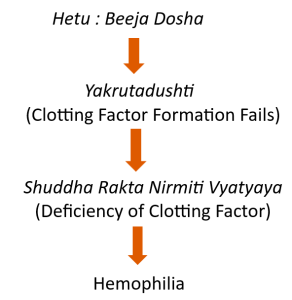
- Hetu : Beeja Dosha
Samprapti :
Lakshane ( Signs & Symptoms )
- Big bruises
- Bleeding into muscles and joints
- Spontaneous bleeding (sudden bleeding inside the body for no clear reason)
- Prolonged bleeding after getting a cut, removing a tooth, or having surgery.
Discussion:
This study shows that Hemophilia, though described in modern medicine as a genetic deficiency of clotting factors VIII and IX, has many similarities with conditions explained in Ayurveda. Modern science explains the disease through mutations on the X chromosome leading to defective clot formation. Ayurveda describes a comparable concept through Beeja Dosha and Adibala Pravritta Vyadhi, which refer to hereditary disorders passed from parents to children.
Both systems agree on the central role of the liver. Modern medicine identifies the liver as the main site for clotting factor synthesis, while Ayurveda considers the Yakrut (liver) as the root of Raktavaha Srotas and the place where Rakta Dhatu (blood) is formed. The Ayurvedic qualities of Ushna and Drava Guna of Pitta and Rakta explain the tendency for prolonged bleeding and difficulty in clotting seen in Hemophilia.
The clinical symptoms like spontaneous bleeding, joint hemorrhages, and easy bruising match the descriptions of Raktapitta, Vatarakta, Raktavrutta Vata, Pandu and Kamala in Ayurvedic Samhitas. Modern treatment mainly depends on factor replacement therapy, but it has challenges such as high cost, limited availability, and development of inhibitors. Ayurveda offers supportive care through balancing Pitta and Rakta, strengthening the liver, and using diet and lifestyle to reduce bleeding tendencies. More clinical researches are required for this to prove it scientifically.
Conclusion:
Hemophilia can be understood in both modern and Ayurvedic frameworks with many overlapping concepts. Modern medicine explains it as a genetic clotting factor deficiency, while Ayurveda links it to Pitta Dosha, Rakta Dhatu, and Beeja Dosha. The liver’s role in both systems shows a strong connection between the two approaches.
Combining standard modern therapy with scientifically validated Ayurvedic methods may improve symptom control and patient quality of life, especially where advanced treatment is hard to access. More studies can be and need to be done to evaluate the same.
References :
- https://www.semanticscholar.org/paper/Hemophilia-and-related-bleeding-disorders
- https://www.haemophilia.org.au/HFA/media/Documents/Haemophilia/Haemophilia-booklet.pdf
- K Sembulingam and Prema Sembulingam, Essentials of Medical Physiology, Tenth Edition Jaypee Brothers Medical Publishers (P) Ltd. New Delhi. Page no. 123
- Kaviraj Ambikadatta Shashtri edited Sushrut Samhita, Sutrasthan, Adhyay14, verse44, (Ayurved Tatva Sandipika Hindi Commentry), Chaukhamba Sanskrit Sansthan, Varanasi 2023
- Kaviraj Ambikadatta Shashtri edited Sushrut Samhita, Sutrasthan, Adhyay24, verse06, (Ayurved Tatva Sandipika Hindi Commentry), Chaukhamba Sanskrit Sansthan, Varanasi 2023
- Kaviraj Ambikadatta Shashtri edited Sushrut Samhita, Sutrasthan, Adhyay14, verse04, (Ayurved Tatva Sandipika Hindi Commentry), Chaukhamba Sanskrit Sansthan, Varanasi 2023
- Kaviraj Ambikadatta Shashtri edited Sushrut Samhita, Sutrasthan, Adhyay21, verse10, (Ayurved Tatva Sandipika Hindi Commentry), Chaukhamba Sanskrit Sansthan, Varanasi 2023
- Kaviraj Ambikadatta Shashtri edited Sushrut Samhita, Sharirasthan, Adhyay04, verse25, (Ayurved Tatva Sandipika Hindi Commentry), Chaukhamba Sanskrit Sansthan, Varanasi 2023
- Ravi Dutta Tripathi edited Charaka Samhita, Vimansthan, Adhyay5, verse8, Hindi commentar and Marathi translation by Vd. Vijay Shankar Kale, Chaukhamba Sanskrit Pratisthan Delhi 2020
- Kaviraj Ambikadatta Shashtri edited Sushrut Samhita, Sharirasthan, Adhyay09, verse12, (Ayurved Tatva Sandipika Hindi Commentry), Chaukhamba Sanskrit Sansthan, Varanasi 2023
- Kaviraj Ambikadatta Shashtri edited Sushrut Samhita, Sharirasthan, Adhyay04, verse10, (Ayurved Tatva Sandipika Hindi Commentry), Chaukhamba Sanskrit Sansthan, Varanasi 2023
- Brahmanand Tripathi edited Ashtanga Hridayam, Sutrasthan, Adhyay03, verse04, (Nirmala Hindi Commentry), Chaukhamba Sanskrit Pratisthan Delhi 2022
- Kaviraj Ambikadatta Shashtri edited Sushrut Samhita, Sutrasthan, Adhyay42, verse08, (Ayurved Tatva Sandipika Hindi Commentry), Chaukhamba Sanskrit Sansthan, Varanasi 2023
- Brahmanand Tripathi edited Ashtanga Hridayam, Sutrasthan, Adhyay01, verse11, (Nirmala Hindi Commentry), Chaukhamba Sanskrit Pratisthan Delhi 2022
- Ravi Dutta Tripathi edited Charaka Samhita, Sutrasthan, Adhyay01, verse60, Hindi commentar and Marathi translation by Vd. Vijay Shankar Kale, Chaukhamba Sanskrit Pratisthan Delhi 2020
- DRAVYAGUNA VIJNYAN (PART I & II) by DR. A.P. DESHPANDE and DR. SUBHASH RANADE, published by Proficient Publishing House in 2016
- Ravi Dutta Tripathi edited Charaka Samhita, Sutrasthan, Adhyay24, verse20, Hindi commentar and Marathi translation by Vd. Vijay Shankar Kale, Chaukhamba Sanskrit Pratisthan Delhi 2020
- Brahmanand Tripathi edited Ashtanga Hridayam, Sutrasthan, Adhyay27, verse40, (Nirmala Hindi Commentry), Chaukhamba Sanskrit Pratisthan Delhi 2022
- Kaviraj Ambikadatta Shashtri edited Sushrut Samhita, Sutrasthan, Adhyay14, verse22, (Ayurved Tatva Sandipika Hindi Commentry), Chaukhamba Sanskrit Sansthan, Varanasi 2023
- Brahmanand Tripathi edited Ashtanga Hridayam, Sutrasthan, Adhyay11, verse04, (Nirmala Hindi Commentry), Chaukhamba Sanskrit Pratisthan Delhi 2022
- Kaviraj Ambikadatta Shashtri edited Sushrut Samhita, Sutrasthan, Adhyay14, verse22, (Ayurved Tatva Sandipika Hindi Commentry), Chaukhamba Sanskrit Sansthan, Varanasi 2023
- Brahmanand Tripathi edited Ashtanga Hridayam, Sutrasthan, Adhyay27, verse02, (Nirmala Hindi Commentry), Chaukhamba Sanskrit Pratisthan Delhi 2022
- Kaviraj Ambikadatta Shashtri edited Sushrut Samhita, Sutrasthan, Adhyay14, verse21, (Ayurved Tatva Sandipika Hindi Commentry), Chaukhamba Sanskrit Sansthan, Varanasi 2023
- Ravi Dutta Tripathi edited Charaka Samhita, Sutrasthan, Adhyay28, verse11, Hindi commentar and Marathi translation by Vd. Vijay Shankar Kale, Chaukhamba Sanskrit Pratisthan Delhi 2020
- Brahmanand Tripathi edited Ashtanga Hridayam, Sutrasthan, Adhyay11, verse04, (Nirmala Hindi Commentry), Chaukhamba Sanskrit Pratisthan Delhi 2022
- Ravi Dutta Tripathi edited Charaka Samhita, Chikitsasthan, Adhyay04, verse08, Hindi commentar and Marathi translation by Vd. Vijay Shankar Kale, Chaukhamba Sanskrit Pratisthan Delhi 2020
- Brahmanand Tripathi edited Ashtanga Hridayam, Nidanasthan, Adhyay03, verse03, (Nirmala Hindi Commentry), Chaukhamba Sanskrit Pratisthan Delhi 2022
- Ravi Dutta Tripathi edited Charaka Samhita, Chikitsasthan, Adhyay16, verse11, Hindi commentar and Marathi translation by Vd. Vijay Shankar Kale, Chaukhamba Sanskrit Pratisthan Delhi 2020
- Ravi Dutta Tripathi edited Charaka Samhita, Chikitsasthan, Adhyay16, verse34, Hindi commentar and Marathi translation by Vd. Vijay Shankar Kale, Chaukhamba Sanskrit Pratisthan Delhi 2020
- Ravi Dutta Tripathi edited Charaka Samhita, Chikitsasthan, Adhyay26, verse13,14,15, Hindi commentar and Marathi translation by Vd. Vijay Shankar Kale, Chaukhamba Sanskrit Pratisthan Delhi 2020
- Ravi Dutta Tripathi edited Charaka Samhita, Chikitsasthan, Adhyay12, verse08, Hindi commentar and Marathi translation by Vd. Vijay Shankar Kale, Chaukhamba Sanskrit Pratisthan Delhi 2020
- Brahmanand Tripathi edited Ashtanga Hridayam, Nidanasthan, Adhyay16, verse33, (Nirmala Hindi Commentry), Chaukhamba Sanskrit Pratisthan Delhi 2022
- https://www.bartshealth.nhs.uk/haemophilia-centre-at-the-royal-london-hospital